


The reconnaissance satellite Yaogan-50 (02) disintegrated in orbit several months after launch. The debris is stuck at a high altitude above the Earth, where the risk of collisions with other vehicles remains for a very long time.
The device went into space on March 15, 2026 on a Long March 6A rocket and successfully entered its intended orbit. We are talking about a rare retrograde orbit, that is, the satellite moved against the direction of rotation of the Earth at an altitude of about 952 kilometers.
After several months of operation, an emergency occurred on the device. On September 4, the US Space Force cataloged 43 fragments from the destruction of Yaogan-50 (02). This was reported by Jonathan McDowell, a former astrophysicist at the Harvard-Smithsonian Center for Astrophysics, who tracks space activity.
The debris is now located in an altitude range of 600 to 1,100 kilometers and remains within a characteristic orbit with an inclination of 142 degrees. It’s the altitude that makes the situation especially frustrating for operators of other satellites.
Debris below 600 kilometers usually deorbits within a few years due to the drag of the residual atmosphere. The higher the object, the slower the braking occurs. According to NASA estimates, at an altitude of about 800 kilometers, orbital degradation lasts for centuries, and above 1000 kilometers, fragments can circle the planet for thousands of years.
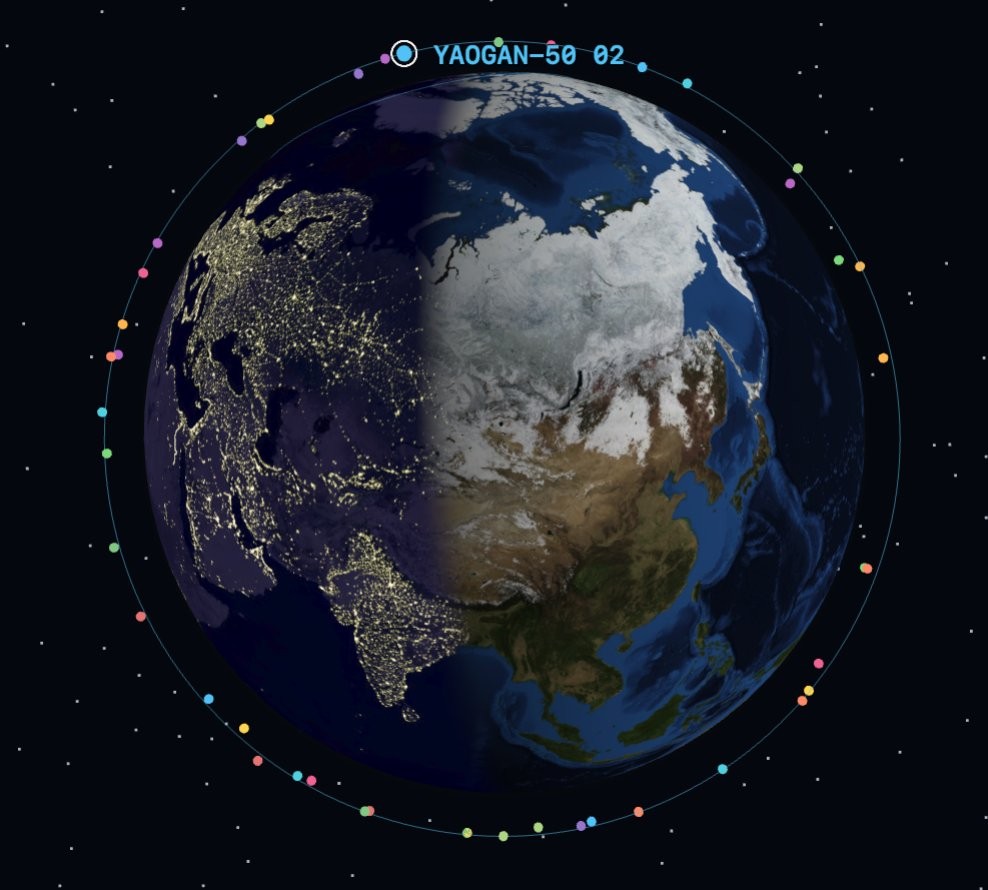
All this time, fragments remain a potential threat to active vehicles and other debris. Any new collision at such speeds generates another cloud of debris, which starts a chain reaction of orbital clogging.
The European Space Agency lists more than 660 explosions, collisions and anomalous events that have led to the fragmentation of objects in space. According to current estimates, there are over 1.5 million pieces of space debris in low-Earth orbits.

Hubble finds a second polar storm near Saturn – a decagon at the south pole

NASA astronaut shows how switching to LED has changed Earth’s cities as seen from orbit
The cause of the destruction of Yaogan-50 (02) has not been officially established. Possible versions include failure of the propulsion system, explosion of the battery, or a collision with another object or debris.
The Yaogan-50 series consists of remote sensing and reconnaissance vehicles. China says the satellites are used for land surveying, crop yield assessment and disaster prevention.


