


In big strategies, the victory screen has long turned into a rare artifact that many have never seen. There is a whole genre where hundreds of hours played do not at all guarantee that the gamer has at least once reached the final year and seen the coveted window with the “exit” button.
An indicative incident occurred in the community Stellaris: The player spent 400 hours in space and stated that he only scored three victories and still does not understand what he is doing. In response, people with two, three and even six thousand hours began to admit that they had never seen the final screensaver at all. One directly said that playing a game to the end, winning or losing, automatically puts a person in the top 1% of all players.
The reason is not complexity. Stellaris by default ends in 2500 with scoring, and victory by superiority or through federation is formalized long before that. The problem is that the “I’ve already won” moment occurs approximately halfway through the game, and formal confirmation requires several more hours of methodically clearing the galaxy.
The second killer of long games is the late game itself. The more settlements, fleets and megastructures, the slower time ticks: old builds were famous for the scenario when one game year took tens of real minutes. Paradox rewrote the population system in update 4.0 “Phoenix”, but people have already developed a habit of abandoning the party at 2350.
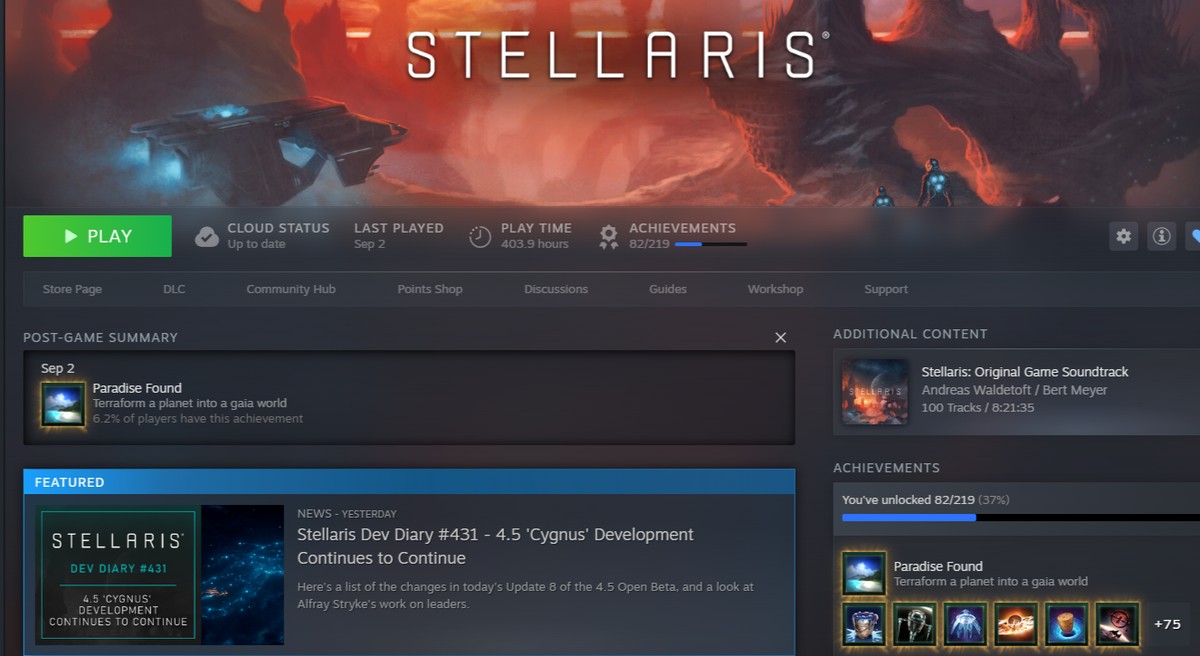
This is where folk therapy against boredom was born. Someone is making Grand Admiral with scaling difficulty so that the early game remains relaxed, but by the end the AI really bites. Someone reduces the galaxy to 600–800 stars for the sake of speed, cuts the slider of habitable planets, or shifts the dates of crises half a century earlier, just so that the chaos begins while it’s still interesting. The rest simply choose the path of “become a crisis yourself” and go to mods like Gigastructural Engineering & More.
And that’s the trick: Stellaris they play for stories that end long before the scores are counted.


