


The release of OpenAI’s GPT-6 Astra followed a familiar scenario – a high-profile presentation, a phased launch and a wave of enthusiasts claiming that the new model was about to put entire professions out of work.
The main topic of discussion was Astra’s ability to take control of a computer and run inside 3D development programs, including Blender. It was this function that testers began to use to “create” their own games.
In practice, demonstrating the independence of the model was reduced to reproducing already existing titles, which were originally invented and assembled by living developers. The results are functionally inferior to the originals in almost all respects, from animation to physics.
At the same time, the authors of the experiments present this as proof that AI is capable of developing games without human intervention.
One of the users under the nickname Zaddy reported on a series of clones collected for a few dollars.
It may soon be cheaper to rebuild or clone games than to buy them from the store… a Super Smash Bros clone cost about $10 in computing, as did Mario Kart and a couple of other titles. assembled on Astra, of course. This is not the level of a full game, there is no online mode, no all maps, but…
Nintendo characters and franchises were predictably the main targets. Rumors about a new part of Super Smash Bros. are actively walking around in front of the next Nintendo Direct, and part of the audience is waiting for the official announcement. AI proponents suggest not to wait at all, because the “new” part already exists.
True, in this version there are no physics and animations, there are no full-fledged modes and at least something outside the starting arena, and all the characters belong neither to the model nor to the person who wrote the prompt. Other attempts don’t look any better. The Sonic the Hedgehog clone lost its color, adequate proportions and the main thing – the feeling of speed.
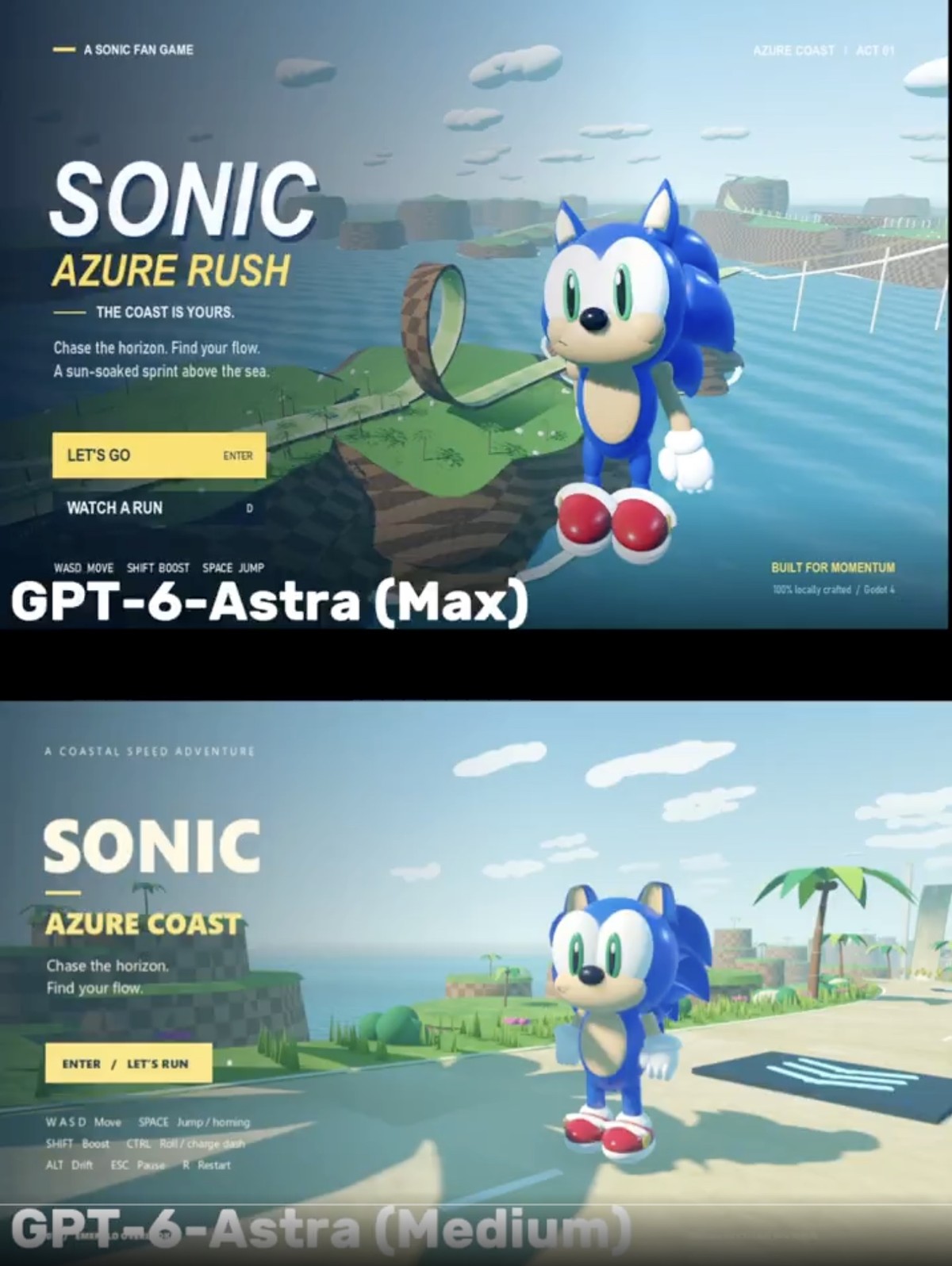
A separate AiBattle account compared two modes of operation of the model on the same task.
GPT-6-Astra (Max) vs GPT-6-Astra (Medium) is a simple 3D Sonic game in Godot. Astra on Max took 53 minutes and used up 4% of the weekly limit on the Pro x5 account. Astra on Medium took 25 minutes and used up 1% of my weekly limit.
Another enthusiast rebuilt Contra from the NES in realistic graphics, but lost the readability of what was happening. Jumps look unnaturally floating, and heroes don’t seem to react to enemy fire. Another attempt to recreate The Simpsons: Hit and Run resulted in a car that doesn’t drive correctly, a complete absence of characters, and a blinding sun in the frame.
It took GPT-6 Astra about 15 minutes to extract this game from the PS2, including the original graphics and maps. The model is currently adding characters and stated that it is using Blender to modernize the graphics.
The common problem with all these demonstrations is the lack of original ideas. Computing resources are wasted on taking what already exists and rebuilding it much worse. Even if we assume that the technology will one day begin to produce something of its own, any result will require refinement, optimization and fine-tuning of the mechanics, without which the game does not turn into playable.

GPT-6 Astra breeds armies of agents and overloads local processors – Intel and AMD are waiting for a surge in demand
A separate issue is the blatant use of someone else’s intellectual property. Cloning Nintendo and Sega franchises publicly, without any rights, is unlikely to go unnoticed by copyright holders.


