


The video, taken through a porthole over the Sahara, shows smooth rows of dunes stretching towards the horizon without a single landmark. The rhythm is repeated so precisely that the first wave of reactions boiled down to jokes about copy-pasting textures and the laziness of the developers.
Fortunately, the discussion went further into the physics of sand and the stories of those who got lost in this desert.
The symmetry is explained by two conditions – the same wind and the absence of significant relief forms. The homogeneous surface does not disrupt the air flow, and the system converges to a simple repeating pattern.
Here is a detailed description of the mechanism from experts:
Every time a dune forms, it cuts off the wind and creates a quiet, sheltered area right behind it where the next dune simply cannot grow. A new sand hill begins to grow only where the wind drops again to the ground, and this happens probably at the same distance each time. In addition, dunes are not static, they move, small ones move faster and crash into large ones, until everything is averaged out, and the entire desert self-organizes itself into such neat repeating rows.
The same principle works in water, only there the particles are billions of times smaller. Self-repetition in nature generally occurs where the system lacks structural complexity.
List of similar examples collected in the discussion:
-
tidal capture of satellites
-
basalt columns
-
stripes of wind currents on gas giants
-
radial “spiders” on Mars
-
hexagon at Saturn’s north pole
-
concentric ridges on Europa
The earth’s crust looks abnormally chaotic against this background. Different rocks, seasons, hydrological cycles and tectonics break the system’s desire for a simple regular pattern, so that such structures seem rare precisely because of the complexity of the biosphere.
Dune mobility has direct practical consequences. The roads drift so quickly that after spending the night it is no longer possible to return the same way, and there are rarely signs in the desert.
A resident of one of the Saharan countries described the situation as follows:
Most of my country is made up of the Sahara desert and a lot of people get lost in the far south, mostly tourists and non-locals, not Tuaregs. Most of them die and their bodies are never found, others go crazy. A terrible fate.
The scale of the problem is illustrated by a story from one of the main trade routes. There is an area on it that is too wide for the supply of water that camels can carry, which is why a second group was sent to meet the caravans with water from the direction of the destination.
Among the famous cases, they remembered the Italian Mauro Prosperry, who got lost during a marathon race in the Sahara and survived due to the moisture from napkins and the blood of bats.
Separately, the story of the Lady Be Good bomber, which disappeared over the Libyan desert, has surfaced. One of the participants told about a teenage trip when a group on motorcycles crossed a couple of dunes and on the way back did not find their own camp, missing it by several kilometers, and were saved only by flares.
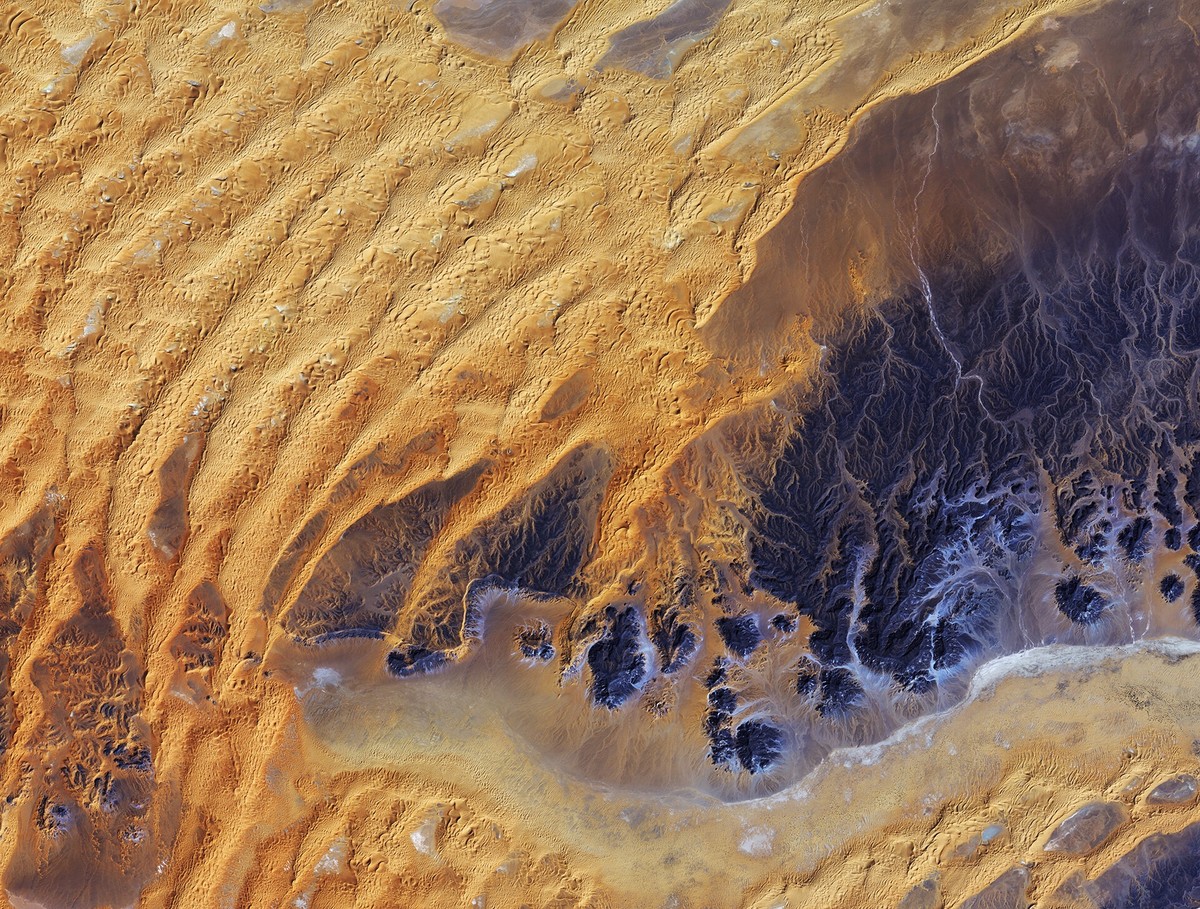
The perception of the Sahara as a continuous sea of sand is a common misconception. Pure sand occupies less than 30 percent of its area, and the rest is made up of mountains, plateaus and rocky areas, and some of the landscapes look completely unearthly.
The desert acquired its current dry appearance as a result of a sharp climate change between 8000 and 4500 years ago. Before that, in its place there were forests and lakes, and even earlier the sea, which is reminiscent of the Egyptian Valley of the Whale with large fossilized skeletons.


