


Anthropic published economic growth model as part of its Economic Index, which should show what the economy will look like by the end of the decade at different levels of AI capabilities and implementation.
The tool is positioned as an aid to policymakers and researchers assessing the impact of technology on the labor market.
It is ironic that the release took place literally the next day after a public statement by one of the company’s employees about the probability of the death of all humanity from AI above 10% within ten years. This scenario is not included in the model itself and is not discussed in the text of the report.

27-year-old Anthropic and OpenAI researcher quits and says AI developers are actually afraid of the end of humanity
The methodology is based on dividing professions into sets of tasks. Next, for each task, it is determined what can be automated, what new work will appear thanks to AI, and what is highly likely to remain with a person.
Different levels of AI penetration are then applied to each profession, allowing the implications for individual industries and the economy as a whole to be assessed. Settings range from zero adoption, in which the economy operates as usual, to extremely aggressive accelerated growth scenarios.
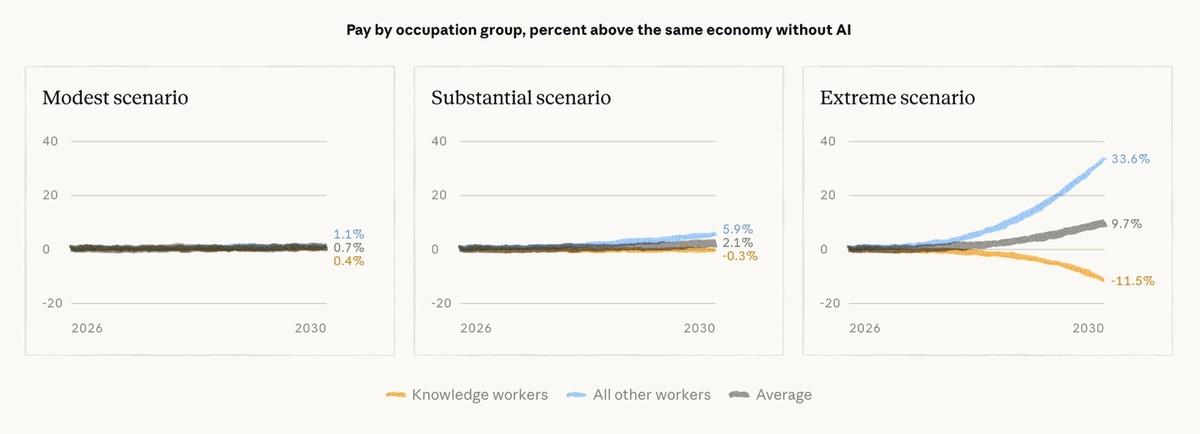
According to Anthropic, while the situation remains in the corridor between business as usual and growth accelerated by AI at approximately twice the norm, unemployment remains within historically normal limits. Salaries for such inductions allegedly remain the same or increase depending on the industry.
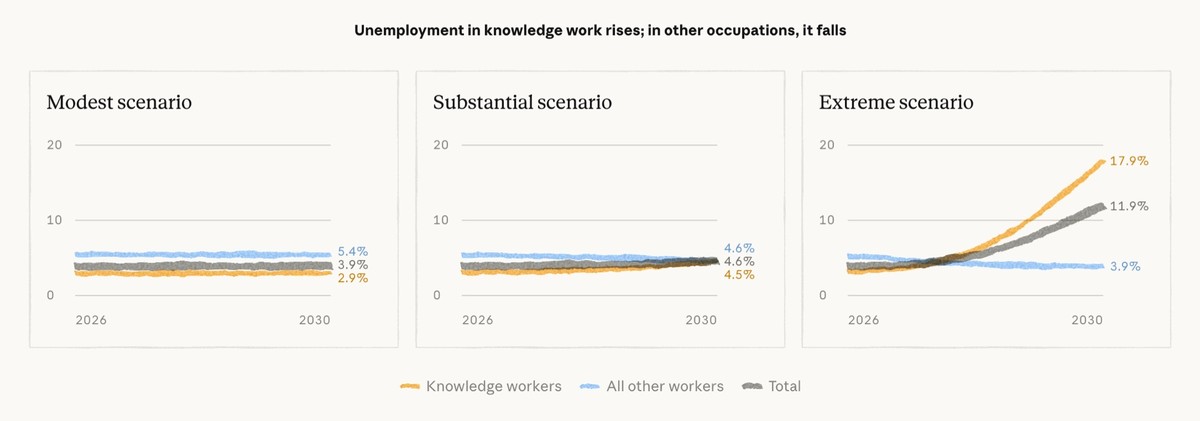
The turning point comes in a scenario where growth is faster than anything economic history has ever recorded. Here the model predicts negative consequences for the wages and job prospects of knowledge workers.
Anthropic on this matter:
In such scenarios, society is much richer, so the challenge is to ensure that benefits are widely distributed.
At the extreme end of the spectrum, the model produces an economy that is 50% larger than today, with an unemployment rate of almost 30%. In other words, the maximum increase in well-being is accompanied by the fact that almost every third able-bodied person remains unemployed.
However, the calculations do not take into account a possible AI bubble and the consequences of deflating it for workers and markets, which are now betting extremely heavily on the reality of the boom. The absence of such a scenario is a noticeable gap given the amount of capital invested in AI infrastructure.
Another option that was not included in the model was identified by Evan Hubinger, head of alignment science at Anthropic. In his publication in X he wrote:
We really sincerely believe that AI can kill all humans!
He estimated the probability of such an outcome to be above 10% over the next decade and admitted:
We do not yet have a plan to solve the alignment problem for superintelligence, and we are clearly not moving toward one.
Anthropic’s economic charts do not show this scenario on any of the axes.


