


Recruitment agency Hiraku Agent published a report on September 16 about how the introduction of AI is changing the requirements for specialists in the Japanese gaming industry.
The study is based on a 2026 survey of approximately 1,008 recruiters at local game studios. The results are compared with data from a similar survey conducted in 2024.
When asked what employers value most in candidates, 32.9% of recruiters cited previous experience and skills. Second place with a score of 30.8% was taken by the ability and willingness to master new technologies, including AI. The third point was an understanding of the games of the studio itself, noted by 27.9% of respondents.

The screenwriter of “Ballads of the Past” for The Witcher 3 wrote her thesis on “Hearts of Stone” – is the plot in good hands?

Billionaire Gabe Newell formulated a universal rule about what makes games interesting 3 years ago – and realism has nothing to do with it
Two years earlier the picture looked different. In the 2024 survey, same experience and skills led the way (35.1%), but were followed by preferred game genres (26.3%) and communication skills (25.1%).
The report concludes that an applicant’s attitude toward AI and ability to work with such tools have become a noticeably more significant factor in hiring than the ability to communicate with colleagues.
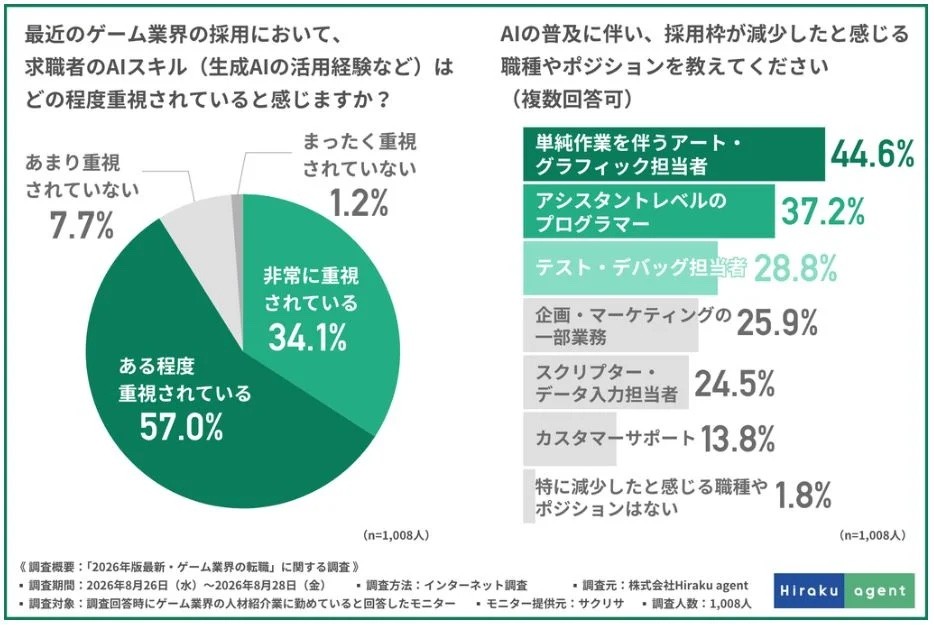
Separately, recruiters were asked how much AI skills, including experience using generative models, are valued in the current environment. The option “extremely important” was chosen by 34.1% of respondents, another 57.0% called such skills “rather important.”
The most revealing part of the study concerns positions for which the number of vacancies has decreased due to the spread of AI. Most often, recruiters pointed to art areas with relatively simple tasks, such as drawing backgrounds and props; this option was chosen by 44.6% of respondents. This is followed by assistant-level programmers (37.2%) and testing and debugging employees (28.8%).
Hiraku Agent attributes the trend to the fact that work that was traditionally performed by young and inexperienced specialists is coming under attack. We are talking about tasks that can be performed according to pre-established rules, which means that they are easier to transfer to AI or automate entirely.
The agency estimates that aspiring candidates will increasingly need to demonstrate a specialized focus or added value beyond “basic” content production, which could make it more difficult to break into the industry.
At the same time, the survey also showed the opposite trend: the demand for specialists capable of effectively using AI is growing. The leaders here were high-level art directors who know how to adjust and direct the results of generative models; they were named by 45.9% of recruiters. In second place with 44.1% are AI engineers and technical artists who integrate AI into development environments and pipelines, in third place are content creators who can quickly produce results using AI tools (34.6%).
Hiraku Agent’s data is generally consistent with general trends. CESA, which runs the Tokyo Game Show, recently published its annual report on the gaming industry for 2026, and according to it, more than 85% of Japanese developers use generative AI in their work, compared to 51% a year earlier.


