


The new version of NVIDIA technology continues to pass through amateur tests, and this time DLSS 5 has reached Apple Silicon.
Enthusiasts launched neural rendering on the M5 Pro chip through an experimental unofficial layer. The result turned out to be ambiguous: the picture was transformed, but productivity collapsed to single-digit values.
The porting was carried out by a developer under the nickname @iamwavecut, who transferred the DLSS 5 neural rendering models to native work with Apple Silicon using the Metal framework. The second participant in the experiment, @Mappsnet7, connected the Metal backend to Windows games via ReShade and Game Porting Toolkit 4.0b2. This combination made it possible to use the 16-core M5 Pro graphics unit without official support from NVIDIA.
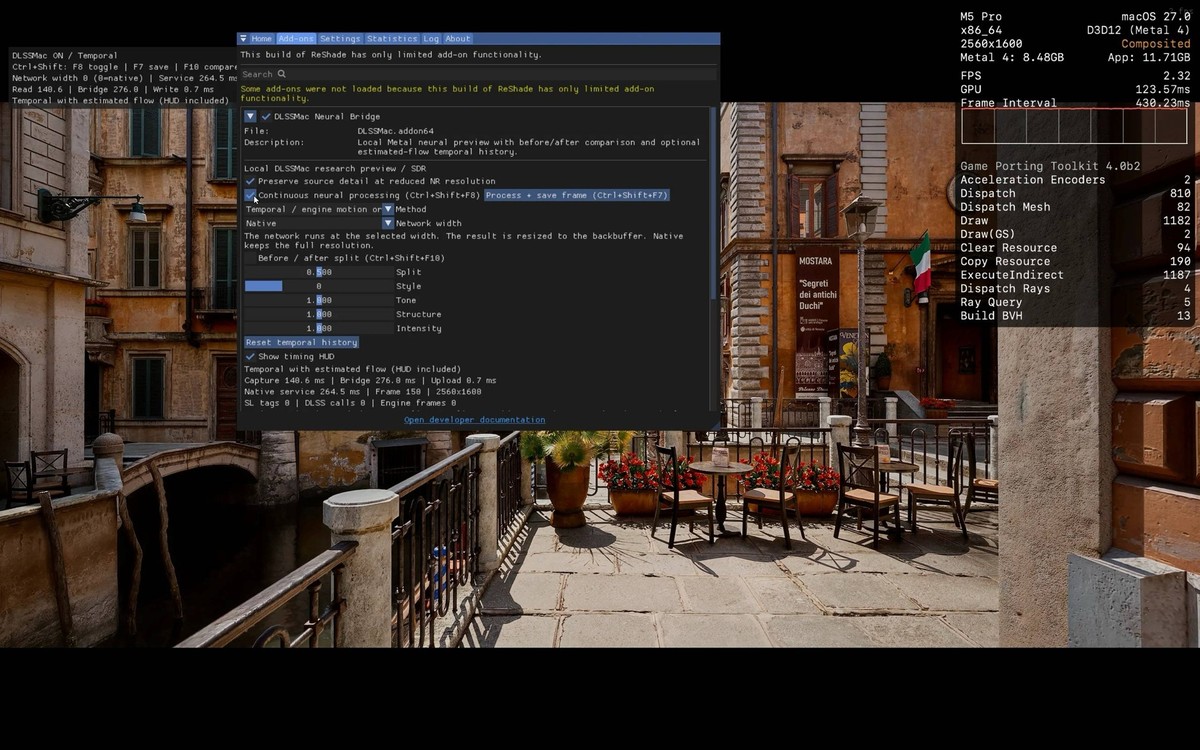
The visual result was noticeable. The screenshots show improved surface lighting, more correct ambient occlusion, and a much more convincing representation of the depth of the scene. It is precisely this set of effects that neural rendering in the fifth generation of DLSS is designed for.
The fee for this seems prohibitive. The frame rate on the M5 Pro dropped to 2.32 FPS, and input lag at 1440p resolution increased to 240ms. For comparison, the desktop RTX 5050 in a similar scenario shows about ten times less latency.


Enthusiast AnyPomelo3352 attributed the failure to the lack of FP8 hardware blocks on which DLSS 5 relies. The Apple chip is forced to pass the neural load along the FP16 path, which is why there is no performance gain. The difference in performance speaks for itself, with the 16-core M5 Pro GPU delivering up to 26 TOPS in FP8, while the RTX 5050 delivers around 105 TOPS.
It is worth considering the overhead costs of the design itself. Running neural inference through ReShade hooks on top of Game Porting Toolkit 4 itself eats up a significant portion of resources, so the numbers reflect more than just the weakness of the FP8 path.
Apple is investing in the gaming direction of its own chips, but the future of graphics technology is increasingly shifting towards neural rendering. Whether FP8 will support the next generation M6 is still unknown, and the current M5 Pro and M5 Max are several generations behind in this regard.


