


Not since the iPhone X, which defined the look of Apple’s flagships for almost a decade, has the company released such an unusual gadget. The iPhone Duo is the brand’s first foldable smartphone, and from first impressions it looks like the most interesting new product from Apple in recent years.
The first acquaintance with the device took place in a closed demo area, where journalists were given hold a real device.
The design is built around two OLED panels – an external one of 5.4 inches and an internal flexible one of 7.6 inches. The Duo’s layout is reminiscent of the original Pixel Fold, but with a noticeably modified body. The side edges have a rounded profile, due to which the device opens almost effortlessly.
The transition animation between the external and internal displays deserves special mention. The interface flows from one panel to another almost seamlessly, and subtle gradients and depth of field effects maintain a sense of continuity. It’s these little things that Apple traditionally takes to a state that is difficult to copy.
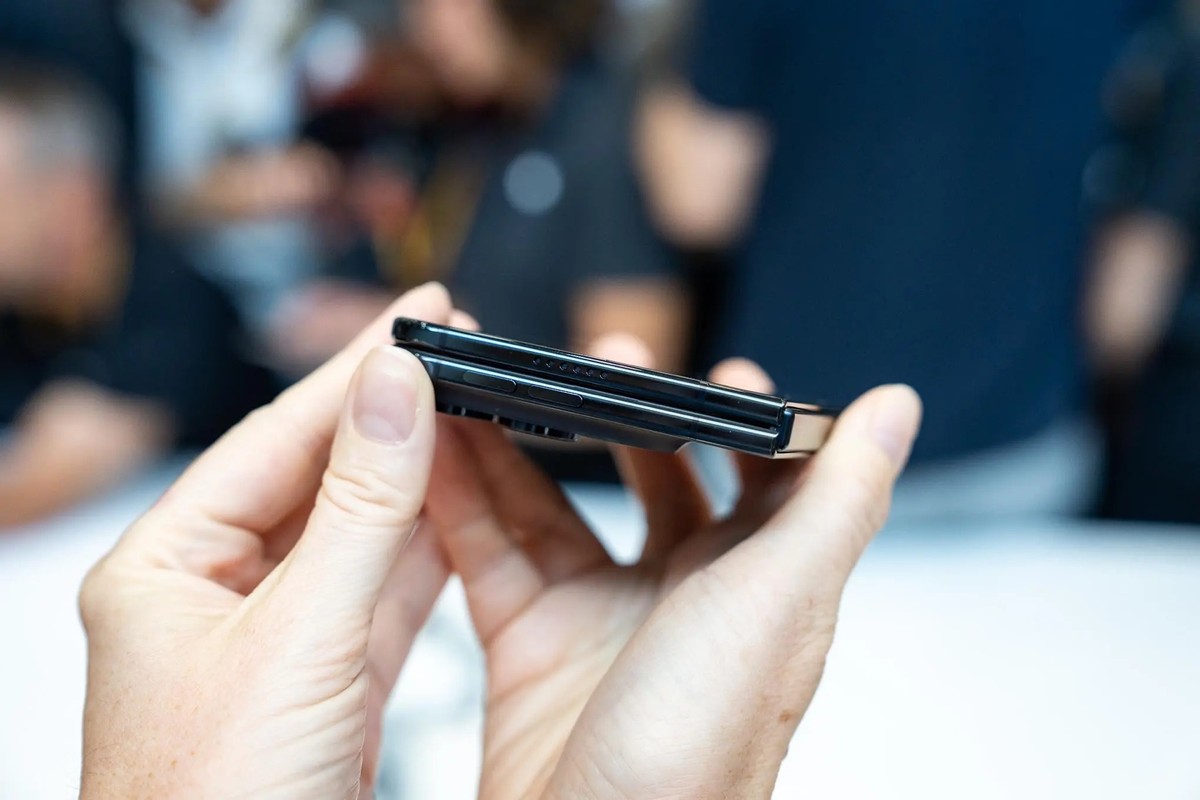
At the same time, the foldable iPhone cannot be called light. The folded thickness is 11.3 mm and the weight is 254 grams, while the Samsung Galaxy Z Fold 8 weighs 201 grams with a thickness of 9.7 mm. The case is made of titanium and has IP68 protection against dust and water.
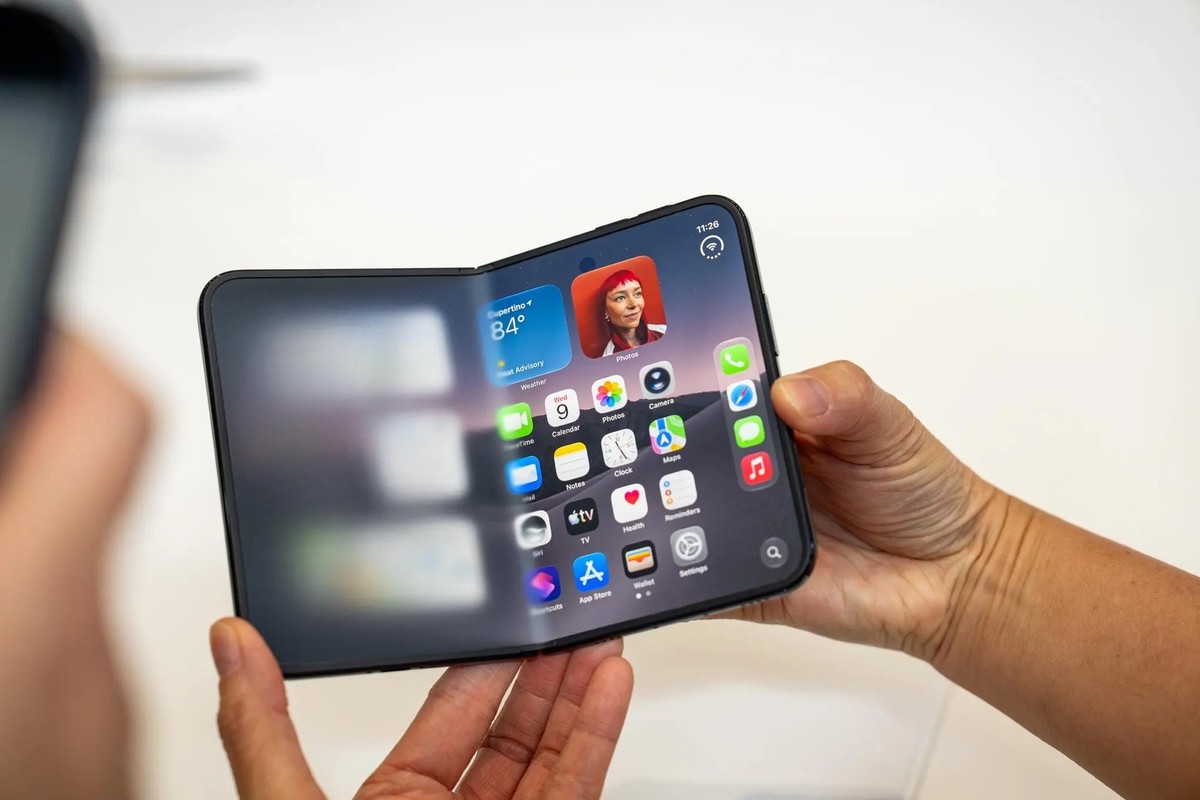
It was not possible to take comparative photos of the Duo next to the Z Fold 8 and the first Pixel Fold – Apple representatives asked not to do this. The difference in size and approach to design between the three folding devices is noticeable to the naked eye upon personal inspection.
The set of controls on the ends is complete – a lock button with a built-in Touch ID scanner, a separate camera control key and a volume rocker. The volume control is placed on the top edge, and when folded, this location is convenient, especially when frequently changing between portrait and landscape orientations. A return from Face ID to the sensor seems like a logical solution for the foldable form factor – unlocking and confirming purchases is faster.
Duo confidently determines the opening angle and supports several operating scenarios at once. Among them are a “tent” mode that turns the screen into a table clock or calendar, a tabletop mode that fixes half of the body, as well as an arbitrary partial bend, convenient for reading e-books.
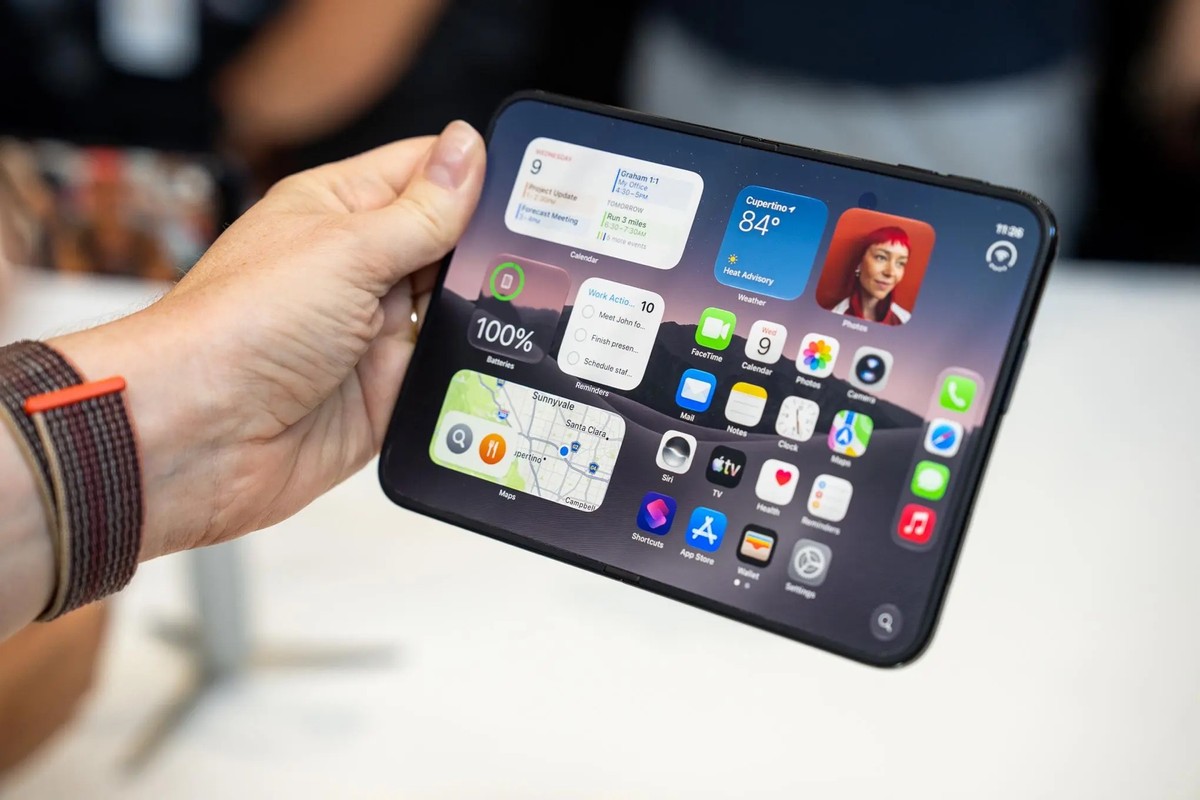
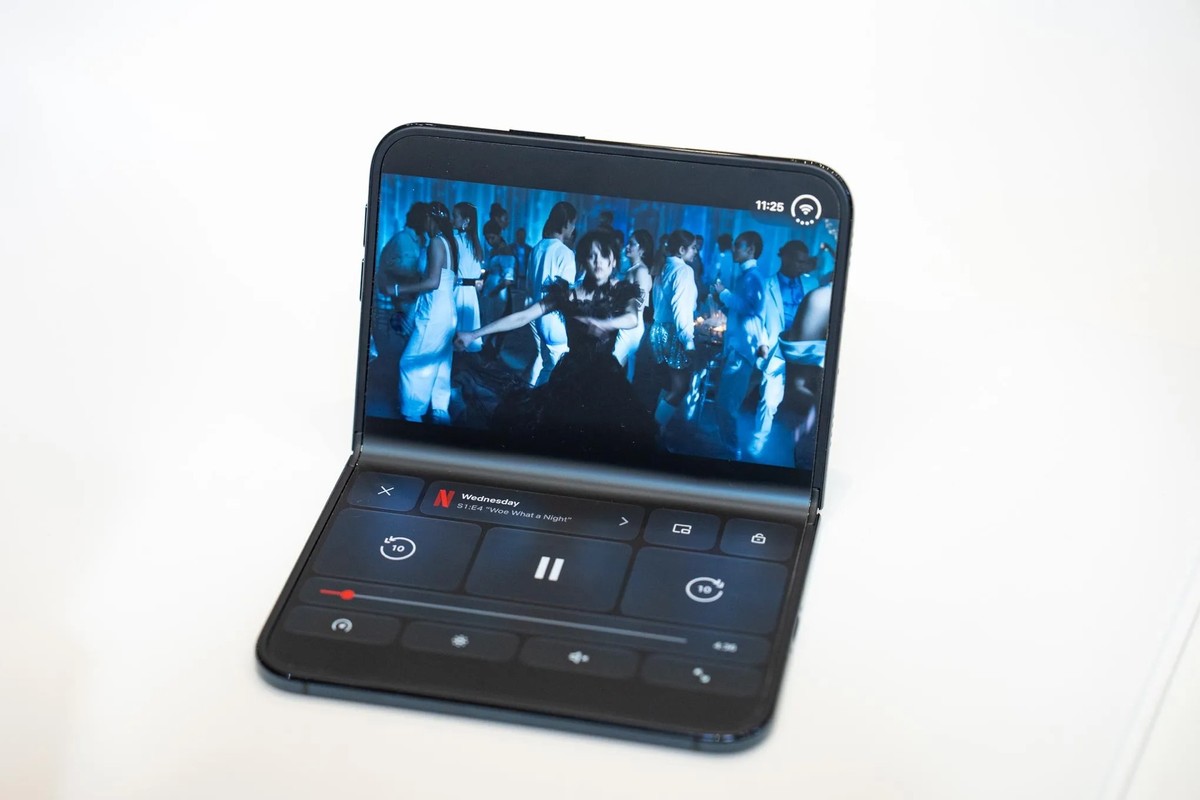


The inner panel is covered with a dense matte nanotexture, and it has several tasks at once. The coating virtually eliminates glare and at the same time masks the crease in the center of the display. The fold has not gone away, but the notch is weak enough that it is easier to feel it with your finger than to see it.
The main technical discovery of the internal screen is the front camera for FaceTime, hidden under the matrix. In the inactive state, it almost completely disappears, revealing itself only as a glossy circle of pixels against the background of a matte surface. Samsung experimented with under-screen cameras back in the 2021 Galaxy Z Fold 3, but in recent generations it has actually abandoned the technology.
Both displays work with Apple Pencil, and the matte texture on the inside should give a more natural writing feel. It was not possible to test this in practice – there were no styluses in the demo area.
The camera block on the rear panel looks more modest than that of its competitors:
-
main Fusion 48 MP with double telephoto mode at 12 MP
-
ultra-wide-angle 48 MP
-
in-display front camera on the internal display
Photos are sharp in a variety of lighting conditions, but there’s no variable aperture like the iPhone 18 Pro line. The full periscope zoom that the Galaxy Z Fold 8 Ultra offers is also missing. But the module is stretched across the entire width of the case, so the smartphone lies on the table without rocking.
Duo’s greatest strength is its software. Multitasking is triggered in several ways. Long press on the application icon and select split screen, or swipe from the bottom and drag programs left or right. You can transfer photos and files between windows by simply dragging and dropping.
There are also app pairings – holding a tab in the middle of a split screen creates a ready-made pair for quick launch. Essentially, Apple has brought much of the iPadOS productivity experience to the foldable smartphone, but in a package that’s easier to carry around.
Based on a combination of solutions, the first foldable iPhone takes the best from its competitors and packages it into a recognizable body. IP68 protection is comparable to the Pixel 11 Pro Fold, the matte interior panel is less reflective than the Z Fold 8, and the polish of the interface is not yet achieved by Samsung, Google and Motorola on Android.
The iPhone Duo is priced $100 less than the Z Fold Ultra and $100 more than the Z Fold 8.
Pre-orders start on October 16, sales will begin on October 23.


