


Road grid in Manor Lords This is how it directs the player to right angles, but one of the medieval city planners went against this logic. In his last batch, he made both the plots and the villages themselves round, turning each settlement into a kind of well-groomed garden. There is no practical sense in this, which the player himself admits.
The result consists of concentric road rings with spaces between them. The gaps are filled with fallow fields, which always have hedges along the edges. The player used them for the sake of contrasting color, and not for the sake of harvest.
Inside the circles are orchards. The upper left ring has only one plot, the rest have two, and each circle grows its own culture. Gardens were not chosen by chance, since they work better than vegetable gardens in non-standard forms, although here everything was done for the sake of appearance.
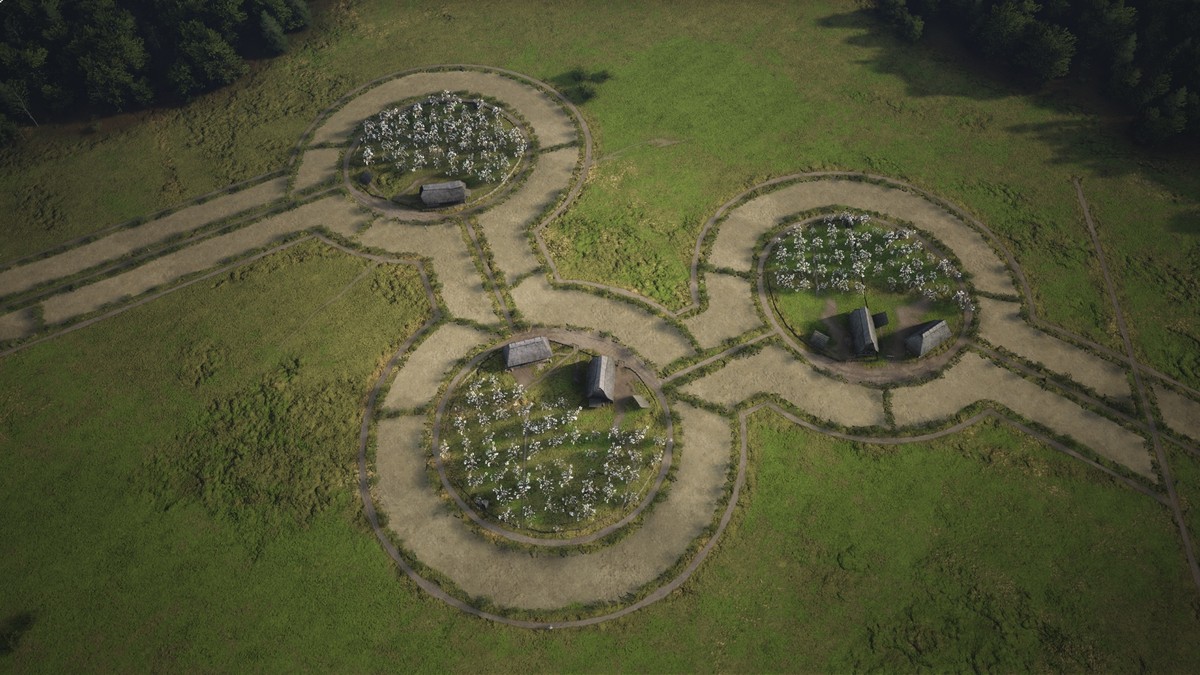
The main question from the community concerned how to construct an even circle. A simple option is to start laying a road, hold down a point and press the camera rotation key several times without moving the mouse until the line returns to the starting point.
The player who assembled the round village used a different method, more tedious, but accurate.
When you draw a road through three or more points, it tends to curve, and this can be exploited. Corpse pits and other structures are suitable for measuring distances and constructing right angles. To get a circle, you need to draw two roads at right angles in the form of a symmetrical X, the end points of which give the four reference points of the circle.
He later posted a full analysis in a separate video. The method, in his own words, is picky and consists of many steps, so he does not advise anyone to repeat it.
The community has also proposed alternative approaches:
-
draw a circle around already round objects in the game, such as a hitching post or a mill
-
cut a circle out of paper, glue it to the center of the monitor and circle the road
-
put a mill, circle a road, add a stable around it, then a road again and repeat
-
mark four reference points manually for each plot
A separate difficulty arises when fitting a circle between existing buildings, since it is almost impossible to find the correct center of rotation. One of the players said that he tried to build a ring city, but ended up with something similar to a Roman fort.
The functional cost of such solutions is obvious. Residents in the game walk, and spaced out buildings lengthen each route. In scenarios with raiders or advancing armies, compact development is also needed to leave room for maneuver during defense.
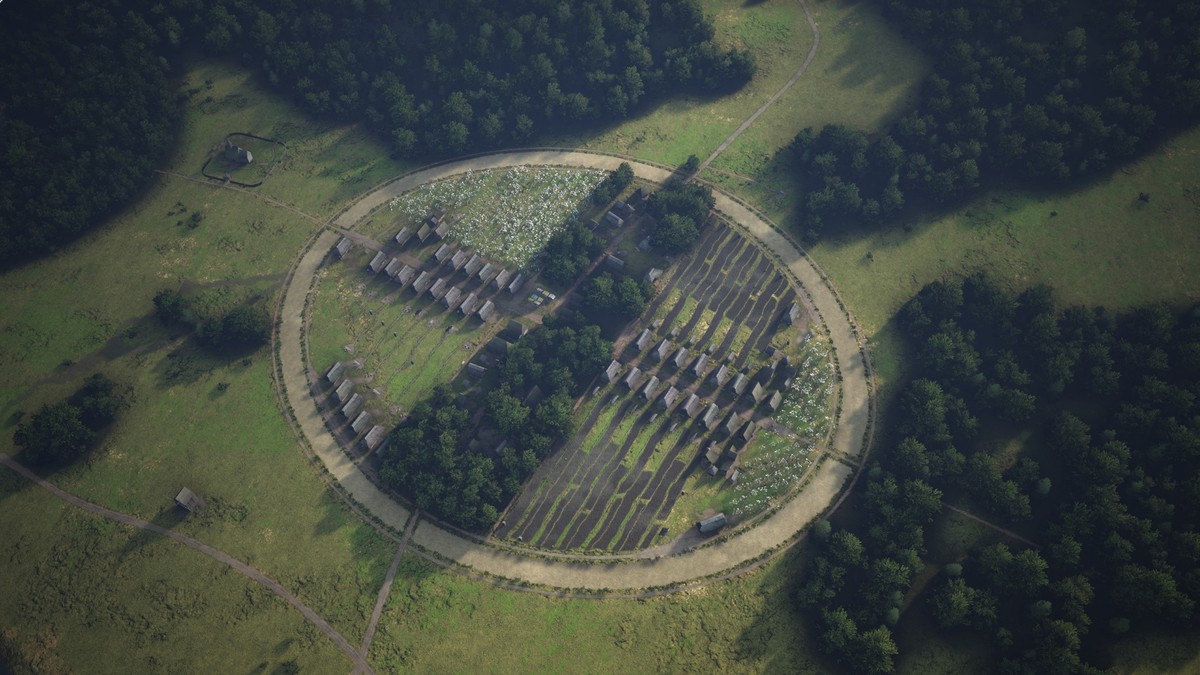
Straight roads are more efficient for the same reason, and rectangular fields are preferable to round ones, since oxen have to turn around less often when plowing. Round buildings are needed for those who have already passed this optimization stage and want to experiment with the appearance.
The player names hexagons as the next target. The main difficulty lies in constructing the exact angle of 120 degrees, and he derived the solution geometrically using a ruler and compass. Reproduce the diagram using tools Manor Lords It’s possible, but the number of steps there is noticeably greater than that of a circle.
Other city planners recalled that tabletop wargames switched to a hexagonal grid for a reason half a century ago. The usual way of constructing a hexagon relies on incremental rotation, which is almost never seen in city planning simulators, and for the same reason 3D models are built on triangles.


